Norfolk, VA
Concrete patios in Norfolk and Hampton Roads
A patio is the piece of concrete people actually spend time on, so it gets judged on how it looks in a way a driveway never does. New patio slabs, extensions onto existing ones, and replacement where an old slab has settled away from the house.
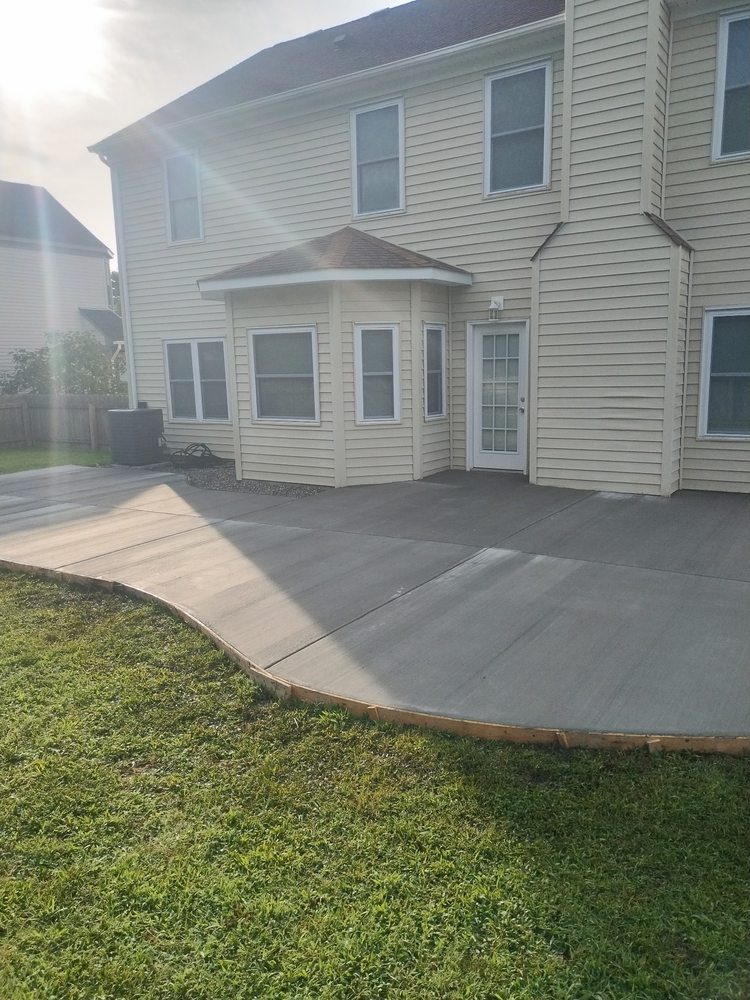
Laying out a patio
Layout is the part worth slowing down for, because a patio is sized for furniture and for people rather than for a vehicle. A slab that looks generous marked out on the grass is often tight once a table and chairs are on it and somebody needs to walk around the back of a seat. It is worth standing in the space with the shape marked before anything is formed.
Shape is more open than it is on a driveway. Square and rectangular slabs are the most common and the most economical to form, but curves, angles and stepped edges are all formable. Every deviation from a straight line costs forming time, so it is a trade between the shape you want and what it takes to build.
Where the patio meets the house is the detail that matters most. The slab slopes away from the building, always, and it sits below the level of any door threshold and below the siding line. A patio that slopes back toward a house, or that is poured too high against the wall, puts water where it does the most damage.
Base, thickness and jointing
A patio carries far less load than a driveway does, so the thickness is usually lighter. That does not make the base less important. A patio that settles at one corner is more noticeable than a driveway that does, because furniture sits on it and a table with one leg off the ground announces the problem immediately.
Excavation, removal of soft material and a compacted base go in the same way they do on any slab. On the waterfront lots that are common around here, the subgrade can be sandy and wet, and that is worth correcting properly rather than working around.
Jointing on a patio is a visual decision as well as a structural one, because the joints will be looked at. Spacing is set to the thickness and the shape, and the layout is planned so the joint pattern reads as deliberate rather than as something cut in afterward to hit a number.
Finishes
Broom finish is the standard and it is a good answer for a patio, since it gives grip underfoot when the slab is wet. A float finish is smoother and reads a little softer. A trowel finish is smoother still, and it is generally the wrong choice outdoors because it gets slick in the rain.
Decorative finishes are available where a project calls for one, including stamped and textured work. Those are a different scope and a different price, and they are worth discussing at the layout stage rather than after the forms are set, because some of them change how the slab has to be poured.
Extending or replacing an existing patio
Extending a patio means tying new concrete to old, and the honest thing to say is that the new section will not match the color of the existing one. Concrete cures to a shade that depends on the mix, the weather that week and how long it has been down. An extension that is meant to look seamless usually is not, and it is better to know that before the pour than after it.
Where the existing slab has settled or broken up, replacement is often the better value than trying to blend into it. Most patios that have settled did so because of what was underneath, so the correction happens below the surface or the new work goes the same way the old work did.
Questions
Common questions
What size should a concrete patio be?
Size it for the furniture and the walking room around it rather than for a number. A shape marked out on the ground with the table and chairs in place tells you far more than a dimension on paper does, and it is the cheapest change you will ever make to the job.
Can you match a new patio to my existing concrete?
Not exactly, and anybody who promises a match is overpromising. New concrete cures to a shade set by the mix, the weather and time. An extension will read as newer than the slab beside it, and it evens out somewhat over the first year without ever becoming identical.
What finish is best for a patio?
Broom finish is the standard and gives grip when the surface is wet. Float is smoother. Trowel finish is usually wrong outdoors because it gets slippery in rain. Decorative and stamped finishes are available and are best decided before forming.
How far should a patio slope away from the house?
Enough that water leaves rather than sits, usually around a quarter of an inch per foot, and always away from the building. The slab also sits below the door threshold and below the siding line. Getting this wrong is the single most expensive mistake on a patio, because the damage shows up in the house rather than in the concrete.
Can a patio be poured around an existing structure?
Yes. Slabs are regularly poured around posts, columns, stoops, utility pads and the footprint of an existing deck. Those get isolation joints so the two elements can move independently rather than pulling against each other.
How long does a patio pour take?
The pour itself is usually a day. The work around it is longer: layout, excavation, base preparation and forming come first, and the slab needs time before it takes traffic. The specific schedule comes with the estimate rather than as a general rule.
Tell us what you are looking at
Call, or send it through the form with the location. Either reaches the same person.